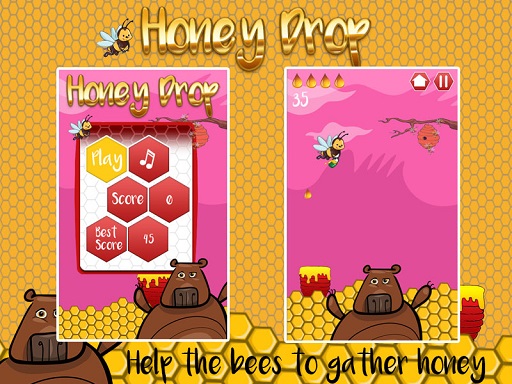
Honey Drop Puzzle Arcade
Reviews
Honey Drop Puzzle Arcade keeps its scope narrow: one mechanic, one objective, and a difficulty curve built from distance and obstacles. That focus works in its favor for players who want a calm, repeatable challenge rather than variety. The family-friendly presentation and simple tap controls lower the barrier to entry, though the minimal design means players seeking depth or fast-paced action will likely lose interest quickly.
About This Game
Timing Is the Whole Game
Honey Drop Puzzle Arcade builds its challenge around a single decision: when to release a honey drop. The bee moves, and you tap or click to let the honey fall. Land it in the pot and the level continues; mistime it and the drop is lost. There is no combat, no resource management, and no complex control scheme. The entire skill ceiling comes from reading movement and acting at the correct instant.
How Levels Add Pressure
Each level changes two things: the distance the honey must travel and the obstacles in its path. Those variations force you to adjust your timing rather than rely on a rhythm you already know. Early levels keep the bee's path simple and the pot close. Later levels stretch the distance and introduce obstacles that punish a rushed tap. The difficulty curve is gradual, so the game stays approachable while still demanding sharper timing as you progress.
Who This Suits
The controls are intentionally minimal, which makes Honey Drop Puzzle Arcade easy to start but harder to master. Children can play without instruction, and adults looking for a low-pressure challenge can treat it as a short-session game. The cheerful bee characters and soothing visuals support that relaxed tone. Players who want fast action or deep strategy will find the loop too simple, but anyone drawn to precision-based casual puzzles will get the most from it.
Building Consistency
Improvement comes from watching the bee's movement pattern before acting, not from tapping faster. Rushing leads to missed drops, so patience is a practical strategy rather than just a mood. Treating each failed attempt as information about the next release window helps more than repeating the same timing. A scoring system that rewards precision gives a clear signal when your timing is improving.
Editorial Notes
Compatibility
System Requirements
















































Comments
0 comments