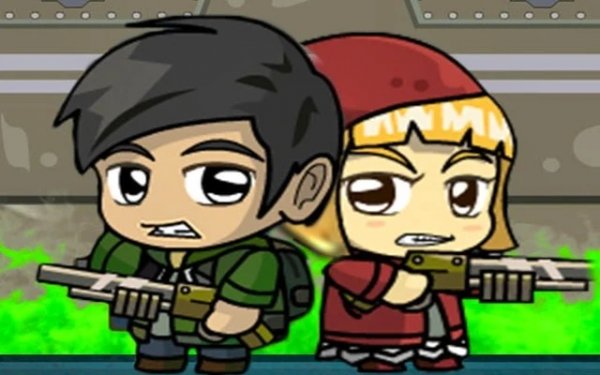
Data Retrieval Duo: Cooperative Maze Puzzle
Reviews
Data Retrieval Duo strips away narrative clutter to concentrate on two-player coordination. Its mazes demand real-time communication, shared route planning, and careful item management rather than individual skill. The gradual difficulty curve makes it accessible to families and newcomers, though later stages require precise timing that may frustrate impatient teams. The clean visual and audio design supports the cooperative focus by keeping both characters and interactive objects easy to track.
About This Game
Two-Player Coordination
Data Retrieval Duo assigns each player control of a single character within interconnected maze environments. Movement, jumping, and object interaction are handled through separate controls, so both players must act in tandem. The objective is to collect data disks scattered across each stage. Because some switches open passages for the other character, progress often hinges on one player holding a position while the partner advances. Real-time communication is not optional; it is the primary tool for solving every level.
Maze Structure and Obstacles
Each stage presents a distinct layout of walls, platforms, and interactive elements. Moving barriers and timed gates force players to plan routes rather than react on impulse. As the game progresses, mazes grow more intricate, introducing branching paths and multiple disk locations. Teams must decide whether to split up for faster coverage or stay together to solve puzzles that require simultaneous actions. The environment itself functions as a puzzle, rewarding careful observation over rushed movement.
Items and Strategic Choices
Special items appear throughout levels and offer temporary advantages: increased movement speed, the ability to reach high platforms, or tools to clear blocked paths. These items are limited, so deciding when and where to use them becomes a strategic layer on top of coordination. Some puzzles require one player to carry an item to a specific location while the other clears a path. Teams that discuss item placement and timing before acting tend to avoid wasted resources.
Progression and Accessibility
New mechanics are introduced gradually, allowing players to master basic coordination before facing more complex challenges. Early levels feature straightforward mazes with few obstacles. Later stages combine multiple puzzle elements that demand precise timing and split-second decisions. This curve keeps the experience approachable for newcomers while offering satisfying difficulty for experienced players. Because success depends more on teamwork than individual skill, each completed level feels like a shared achievement. The clean, colorful visual style uses distinct character designs and highlighted interactive objects to keep both players visible and oriented on screen. Audio cues for item pickups and puzzle completions provide feedback without requiring constant visual attention.
Editorial Notes
Compatibility
System Requirements







































Comments
0 comments