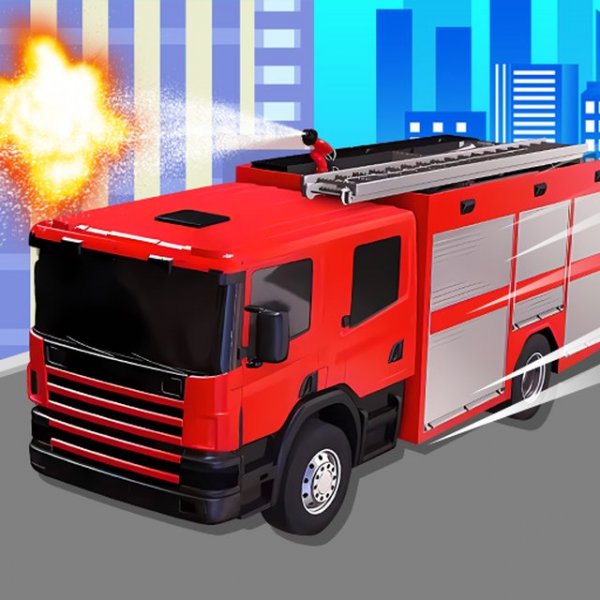
Emergency Vehicle Response Challenge
Reviews
Emergency Vehicle Response Challenge stands out by making traffic itself the puzzle. Instead of simply driving fast, you read congestion on a map and adjust routes in real time. The countdown timer adds urgency without stress, and the gradual increase in city complexity keeps missions from feeling repetitive. It suits players who enjoy light strategy and accessible controls. The main limitation is that the input does not describe multiplayer or vehicle variety, so the experience appears focused on solo route optimization.
About This Game
Route Planning Under Pressure
The central task in Emergency Vehicle Response Challenge is getting from a starting point to an incident location as efficiently as possible. A countdown timer runs during each mission, but the game is designed so that urgency never becomes frustrating. The real challenge comes from reading the road ahead: when a direct path is blocked by congestion, you must open the city map, study available roads, and choose an alternative route. Directional markers keep you oriented toward the destination, and parking in the designated zone completes the objective.
Reading Traffic and Adjusting on the Fly
Traffic patterns are not static decoration. The map interface highlights congested areas, giving you the information needed to make real-time adjustments. You might start down one street, see a jam forming, and switch to a side road before losing too much time. This back-and-forth between driving and map-checking is the game's defining rhythm. [IMG_1] Each decision has a visible consequence: a well-chosen detour saves seconds, while a poorly judged route costs them.
Progression Through Increasing Complexity
Missions are not one-size-fits-all. As you complete arrivals, the city layout gradually becomes more intricate, introducing more road networks and trickier traffic scenarios. Early missions let you learn the map and basic controls; later ones demand faster analysis and better anticipation of where delays will appear. The difficulty curve is gentle enough for younger players but still offers strategic depth for adults who enjoy optimizing routes.
Controls and Platform Accessibility
Movement uses standard keyboard controls, and the interface is built around a city map that shows roads and congestion. Because the game runs on modern web technology, it works on desktop computers, tablets, and smartphones with a browser. The simple control scheme lowers the barrier to entry, while the route-planning layer keeps the experience from feeling mindless. [IMG_2]
Editorial Notes
Compatibility
System Requirements















































Comments
0 comments